
Cezanne in New York: Hans Hofmann’s Cezanne
Nancy Locke
Cf. Colloque « Odyssée Cezanne », 25–27 September 2025.
On 28 August 1950, the German-born American artist Hans Hofmann, who was 70 years old and already recognized as an important abstract painter and influential teacher, gave a talk for the Art Association of Provincetown, Massachusetts. “Abstract art,” Hofmann said,
goes back to Cézanne, who charged his pictures to the limit of his palette.—His highly saturated and powerful work is marked by great simplicity. It is the accumulation of quality that makes it so simple. Cézanne’s revolutionary principles of composition brought nature “as experience” again under pictorial control.[1]
The last words in that passage were underlined: “brought nature ‘as experience’ again under pictorial control,” and in this talk I would like to consider what Hofmann might have meant. How did an audience of artists and art amateurs in 1950 in the U.S. understand what Hofmann had to say? What was going on in Hofmann’s work that he was still grappling with Cezanne, who had become the artist of the moment back when Hofmann first went to Paris in 1904?[2] Most of all, what did Hofmann make of Cezanne, and how would Hofmann’s trajectory from Bavaria to Paris, and Paris to New York become an important strand of the transmission of Cezannian artistic principles in the first half of the twentieth century in the United States?
In terms of the presence of Cezanne in New York in the early twentieth century, John Rewald and Jayne Warman have made significant contributions to our understanding, and Mary Tompkins Lewis has written about Hans Hofmann’s debt to Cezanne.[3] In this paper, I would like to build on this foundation and to look more deeply into not only the theory of Cezanne’s art or Cezannian modernism that informed Hofmann’s work, but also the form that is created once the brush hits the canvas across the Atlantic. For this reason, I will be looking at specific Cezannes exhibited in New York, and trying to explicate Hofmann paintings in terms of his responses to those works.
Earlier this year, the exhibition Lillie P. Bliss and the Birth of the Modern at the Museum of Modern Art in New York emphasized the centrality of Lillie Bliss’ collection of Cezannes to the foundation of that museum.[4] Works like Still Life with Apples, which appeared on the exhibition publicity materials, or The Bather, which has long been an icon for MoMA’s collection of modernist painting, served as touchstones for the exhibition.[5] In the first half of the twentieth century, however, several exhibitions of the Bliss collection included works that did not remain in the Museum of Modern Art. One such work was Cezanne’s portrait, Victor Chocquet Seated (fig. 1).[6] Although it was part of Lillie Bliss’s bequest to MoMA, it was deaccessioned in 1941, turned over to Paul Rosenberg, and eventually sold to the Columbus Museum of Art in Columbus, Ohio, where it has remained since 1950.[7]
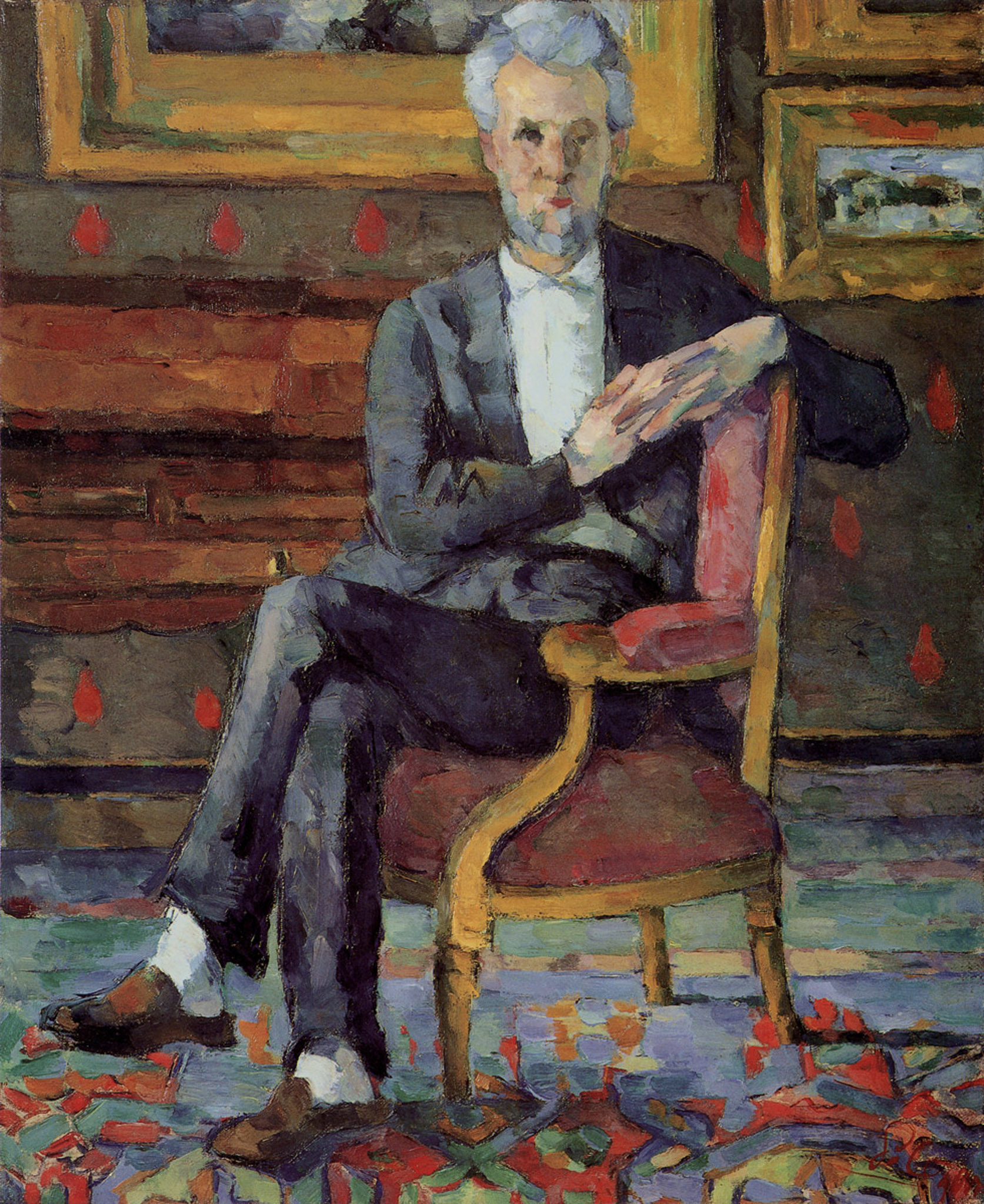
Portrait de Victor Chocquet assis, 1877
FWN 439
Hans Hofmann had already seen Cezanne’s work in Paris, where he lived from 1905 to 1913.[8] He traveled to the United States in 1930, and after teaching in Berkeley that year and in 1931, then in Los Angeles in 1932, he moved to New York in September, likely missing the inaugural 1931 exhibition of the Lillie P. Bliss collection at MoMA in the middle of the year.[9] The Bliss collection would be shown again, however, in mid-1934, and Victor Chocquet Seated was included in a MoMA anniversary exhibition in late 1934/early 1935. With Hofmann founding his own School of Fine Arts at 137 E. 57 Street in New York in mid-1934, it is almost certain that he saw this painting in 1934 or 1935.[10]
What would Hofmann have made of this small painting, just 46 centimeters high, especially given the extent to which his own painting was still steeped in School of Paris work, as well as that of Henri Matisse, in the mid-1930s? The geometries that Meyer Schapiro wrote about would surely have registered with Hofmann.[11] The chromatic harmonies of the yellow-gold frames and the gilt Louis XIV chair, the red of the upholstery and the red components of the carpet stand out, even before one registers the red teardrop shapes against the dark green wallpaper. Schapiro describes it as a “constructed form”: “The whole is a banding and fitting of mainly horizontal and vertical strips of rich color, like a section of mosaic or a patchwork rug.” “The principle is clear,” Schapiro continues: “to unite on the picture surface what lies at different depths.”[12] Even if many Cezannes, including ones as early as 1877, interlock foreground and background, the portrait of Chocquet Seated might well be a limit case of Cezanne bringing every pictorial element into contact on one very active plane. The more one studies the red teardrop shapes, the more it appears that Cezanne moved from representing shapes in wallpaper to finding more shapes—in the mahogany piece of furniture, on the picture frame at right, in areas of the red upholstery—and even seeing to it that Chocquet’s mouth took the place of a red teardrop from the wallpaper hidden from view.
One painting in which I think we see Hofmann trying to put to work certain formal aspects of Victor Chocquet Seated is Untitled (Interior Composition), with its date of 1935 tying it to the 1934 and 1935 exhibitions of Chocquet Seated in New York (fig. 2).[13]
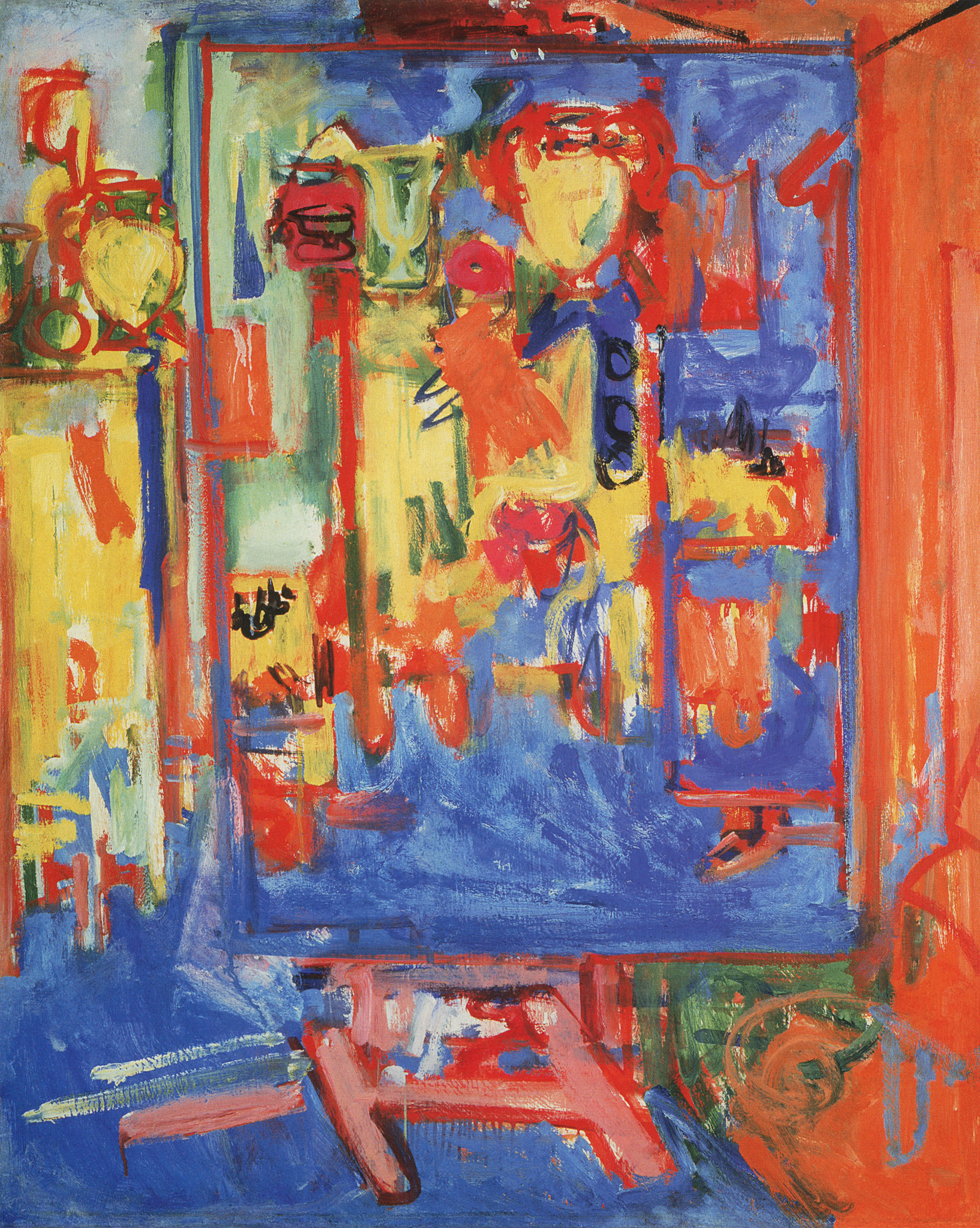
Hans Hofmann, Untitled (Interior Composition), 1935
Like Cezanne’s painting, it is an interior with strong rectilinear elements. At a height of 110 centimeters, it is not twice the height of the Cezanne, but it is considerably larger. As Michael Schreyach has written, the painting is part of a series of interiors with a yellow chest of drawers, a yellow amphora, other pots or jars, and an easel with a painting in progress of this very interior with a cupboard, drawers, and the yellow amphora atop.[14] Cezanne’s painting does include works of art from Chocquet’s own collection in the background, but the painting within a painting in the Hofmann constitutes a difference.[15] Looking at it strictly in formal terms, however, many more similarities emerge. If Cezanne makes the yellow frames and chair legs almost vibrate against the green walls and blue carpet, Hofmann takes out Cezanne’s muting and nuancing of the walls, and he has his yellow chest and yellow amphora clash noisily with the blue background on the pictured canvas. One of the things that is wrong with Hofmann’s painting may well be the extent to which all three primary colors—red, yellow, and blue—compete for attention; one sees him leaning more on orange at right and in patches on the canvas, but the red still dominates the orange. Likewise, blue shifts to green (a secondary color) on the left side of the canvas. Cezanne does much, much, more of this shifting to secondary colors. Most of the reds in the Chocquet painting are almost orange or brown, and even the green has been muted considerably. Taking one primary out of the equation and substituting a secondary in its place creates vibrancy without the garishness we see in the Hofmann.
Yet it is clear what Hofmann saw in Victor Chocquet Seated: strong horizontal and vertical elements of yellow and blue, and rounded red shapes simultaneously pinning the wall into place and leaping forward to interact with the green wallpaper or the blue carpet. Hofmann has done exactly this, outlining his amphora in red, creating drawer-pulls, jars, and knobs that are spaced apart and red, especially the red circle in the middle of the array of objects on the chest in the canvas, and the red knob forms on the drawer fronts as they appear in the painting on the easel. We know from the other paintings in the series that the round object next to the yellow amphora in Hofmann’s setup was probably not red at all—he outlines it in red or pictures it as yellow in other paintings, but in Untitled (Interior Composition), he makes the pot red to serve a pictorial function like the red teardrops in Victor Chocquet’s wallpaper. Looking at the Cezanne, Hofmann was probably less interested in Cezanne’s rendering of light on Chocquet’s dark suit, and more interested in the expanse of blue the light created, and how it could interact with the yellow and red of the chair. Despite the huge differences in facture, subject matter, and intent between the two paintings, Hofmann turns Chocquet’s head into a yellow amphora in his painting; the amphora is like a trophy set off by red badges strategically placed across the canvas.
Let us recall the quote I started with: Hofmann describing Cezanne’s colors as “highly saturated,” his pictures “charged to the limit of his palette.” For us, looking at Cezanne’s colors in general, we see subtle modulation in tone and hue, although the relations between colors in Chocquet Seated create a vibrant interaction associated with highly saturated colors. Hofmann emphasized the role of color in Cezanne and in painting in general. In his “Notes on Art” of 1950, he writes:
A color seen by itself seems to change into another color in a relation. Its color expressiveness changes within every other relation.
Every color, every color shade suggests volume. Volume is depth. Depth is a dimension.[16]
In this passage, Hofmann zeroes in on a fundamental property underpinning every Cezanne painting: that a color “change[s] into another color in a relation.” One of the easiest places to see this principle in action is in a painting left in an early state, or a watercolor, and this one, Study of Foliage, part of the Bliss collection and still at MoMA, was shown in that same 1934 MoMA exhibition as Victor Chocquet Seated (fig. 3).[17]
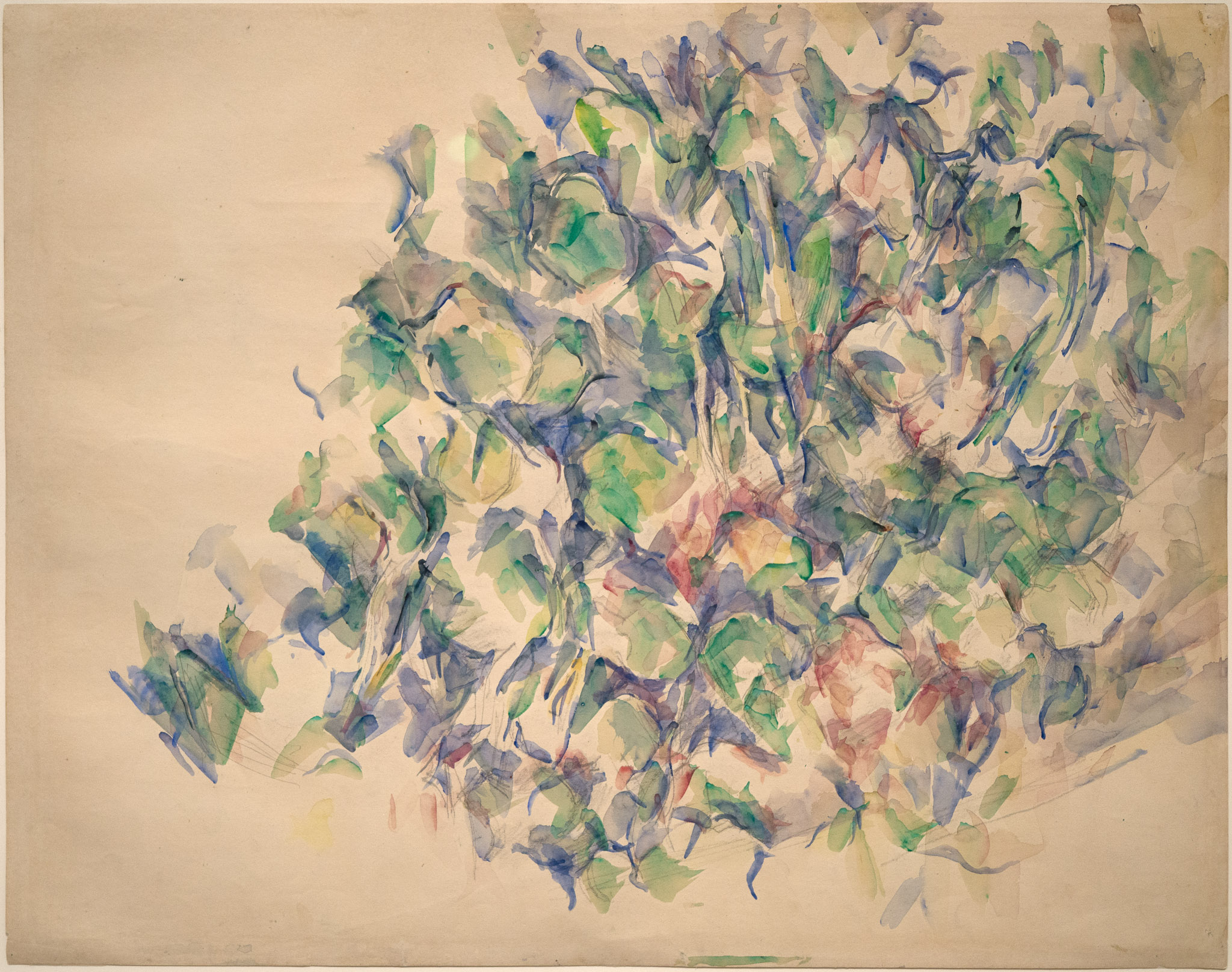
Étude de feuillage, 1900-1904.
FWN 1980
Red appears sparingly in this watercolor, but it is instructive to compare an area in which red appears more on its own, such as the very open blossom in the right foreground, where red acts to render the blossom convex and pushing forward, with areas above the center, in which red juxtaposed with blue can become shadowy and recessive even if the red remains distinct.
I would like to turn back to Hofmann’s 1950 Provincetown talk quoted at the beginning: “Cézanne’s revolutionary principles of composition brought nature as experience again under pictorial control.”[18] What would the idea of “nature as experience” have meant to a painter who interacted with other foreign artists in Paris at the height of Cezannisme in 1907, but who did not, as far as we know, travel to Provence to see the source for Rocks near the Caves above the Château Noir (fig. 4)?[19]
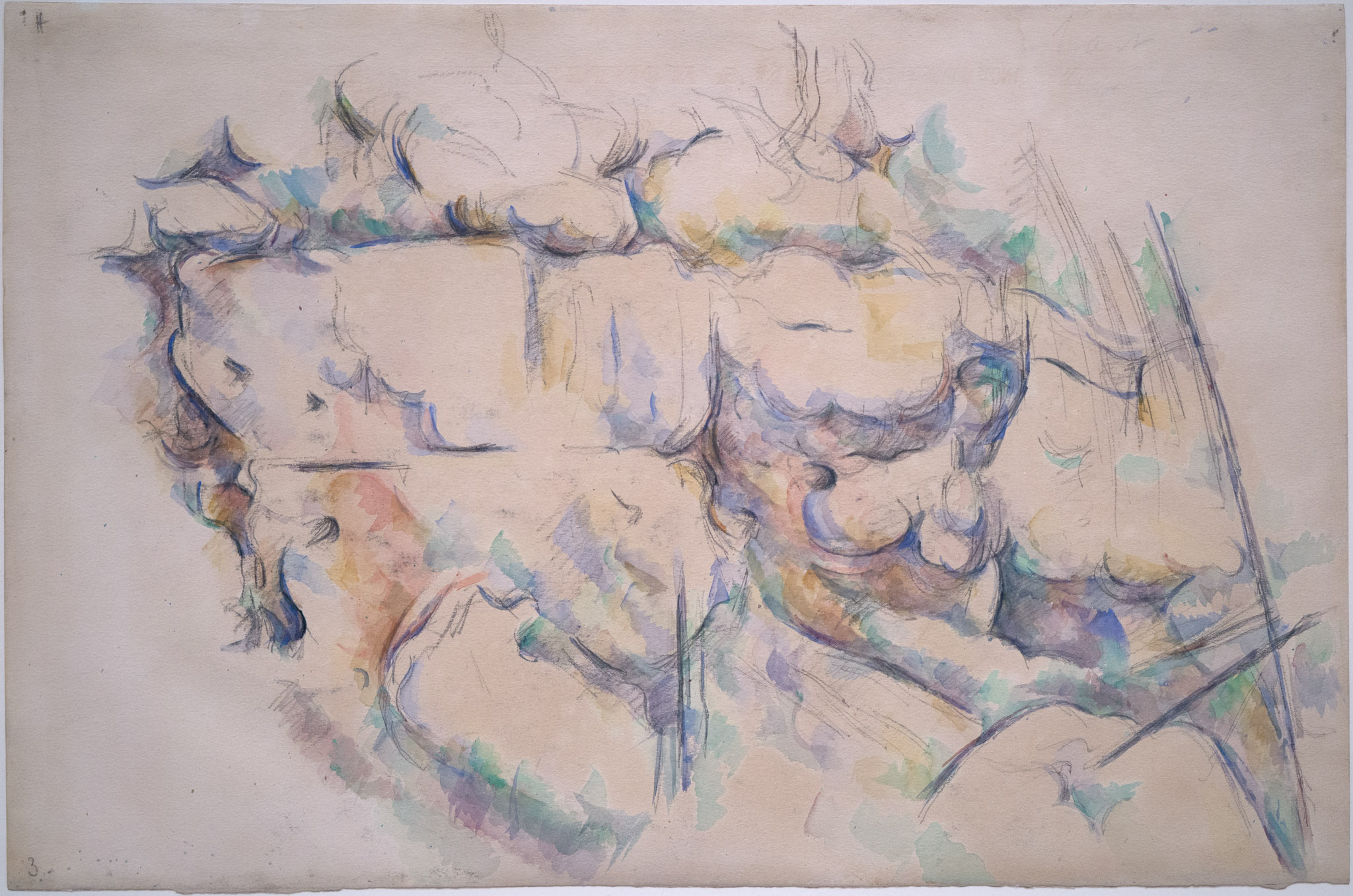
Rochers près des grottes au-dessus de Château-Noir, 1895-1900
FWN 1390
This watercolor too was included in the 1934 Bliss exhibition in New York, but when Hofmann likely saw it, he would not have been thinking of Cezanne’s particular experience of nature around the Bibémus Quarry or the Château Noir. He would have been thinking in more general terms about a human experience of nature. The MoMA watercolor remains a vivid example of anthropomorphized rocks (that resemble nude figures in a Peter Paul Rubens allegory), to which Hofmann adds the idea of being brought “under pictorial control.” Despite the highly variegated nature of the motif, Cezanne uses few colors, creates a unit curve, regularizes the size of the patches of color, and emphasizes a grid-like structure. Indeed, the tension in the work between the irregular or organic and the architectonic or the grid, becomes almost explosive.
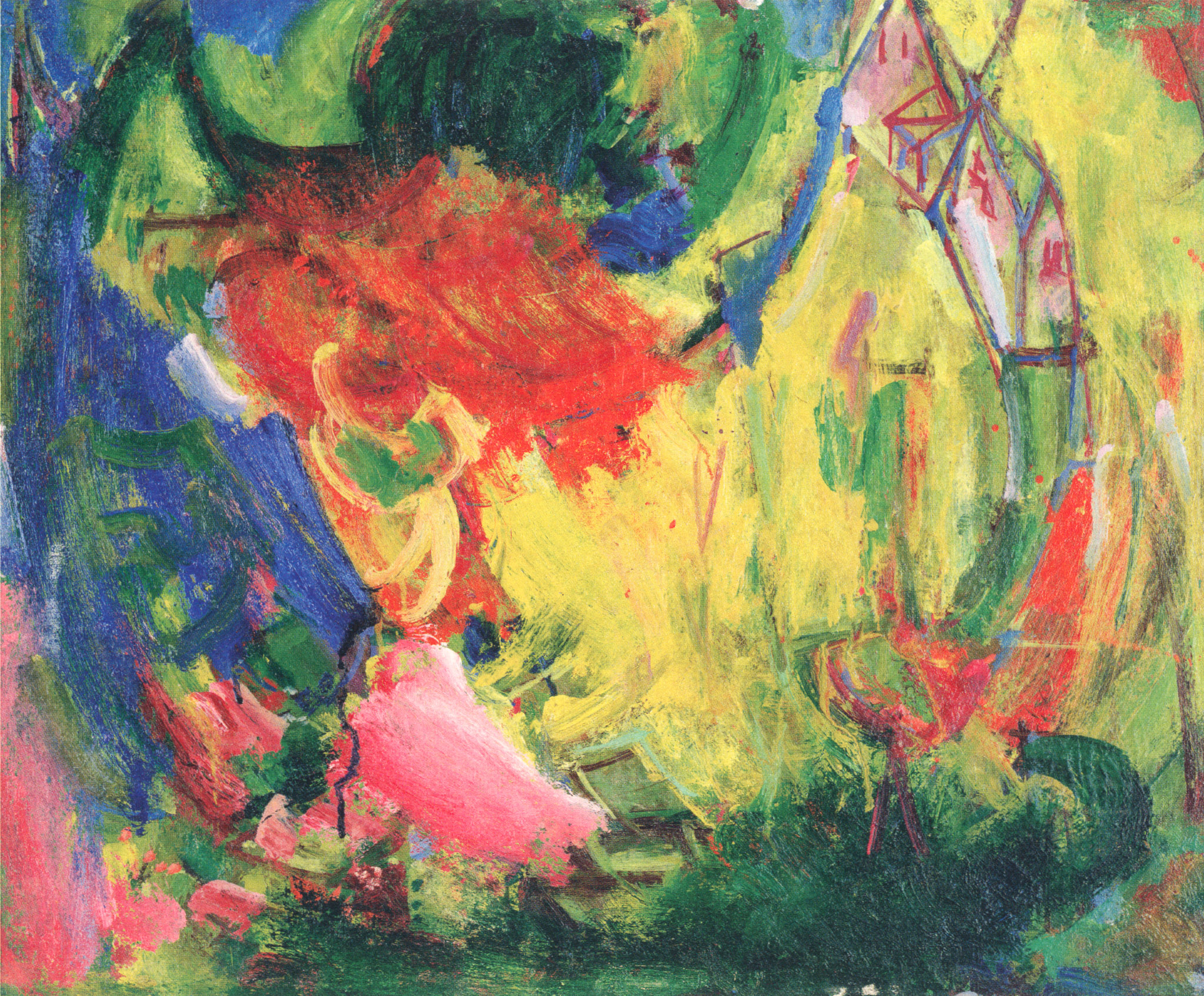
Hofmann tried something like it in House in Storm of 1939 (fig. 5).[20]
Hans Hofmann, House in Storm, 1939
Grid-like lines that hint at orthogonal elements such as walls and a roof are visible across the painting, made on board, and at 51 by 61 cm, the work is smaller than Chocquet Seated. Even if there is a literal house to be found in House in Storm—far from a guarantee given Hofmann’s poetic titles—the more irregular patches of arbitrary color overwhelm the architectural. As in Rocks Near the Caves above the Château Noir, there are pendulous curving forms and larger patches of color over the remains of a grid. The Cezanne watercolor displays more emphatic drawing done late in the process than many watercolors, and Hofmann for his part adds drawing in red, blue, and purple in the upper right. Hofmann’s title evokes the forces of nature even if his palette veers away from the organic.
For Hofmann, an understanding of the ways colors change and function in relation leads directly to his famous theory of “push and pull.”[21] This theory, which was influential to generations of art students, emphasizes the ability to create three-dimensionality across a two-dimensional surface, with color, without making what he called “holes” in the canvas. Depth or three-dimensionality for Hofmann was not the same thing as illusionistic space, but rather a palpable spatial dynamism that was essential to his theory of push and pull. As Mary Tompkins Lewis has noted, Hofmann described “the function of push and pull” by again referring to Cezanne:
At the end of his life and at the height of his capacity, Cézanne understood color as a force of push and pull. In his pictures he created an enormous sense of volume, breathing, pulsating, expanding, contracting through his use of color.[22]
We’re looking at Pines and Rocks, another Lillie Bliss canvas from MoMA’s 1934 exhibition, a magisterial example of volumetric boulders, light pulsating in the pines, and the kind of expansion and contraction through color Hofmann discussed in his 1948 essay.[23] It is beyond dispute that Cezanne deeply informs Hofmann’s great theory. As we see in this key passage, it is color that lies at the heart of “push and pull.” With respect to color, Hofmann distinguished between what he called “tonal painting” and his idea of “pure painting,” which was “the antithesis of tonal painting.”[24] So-called “tonal painting” “degraded” color “to a mere black and white function;” Hofmann noted that “Tonal gradation can be produced by any kind of color mixture.”
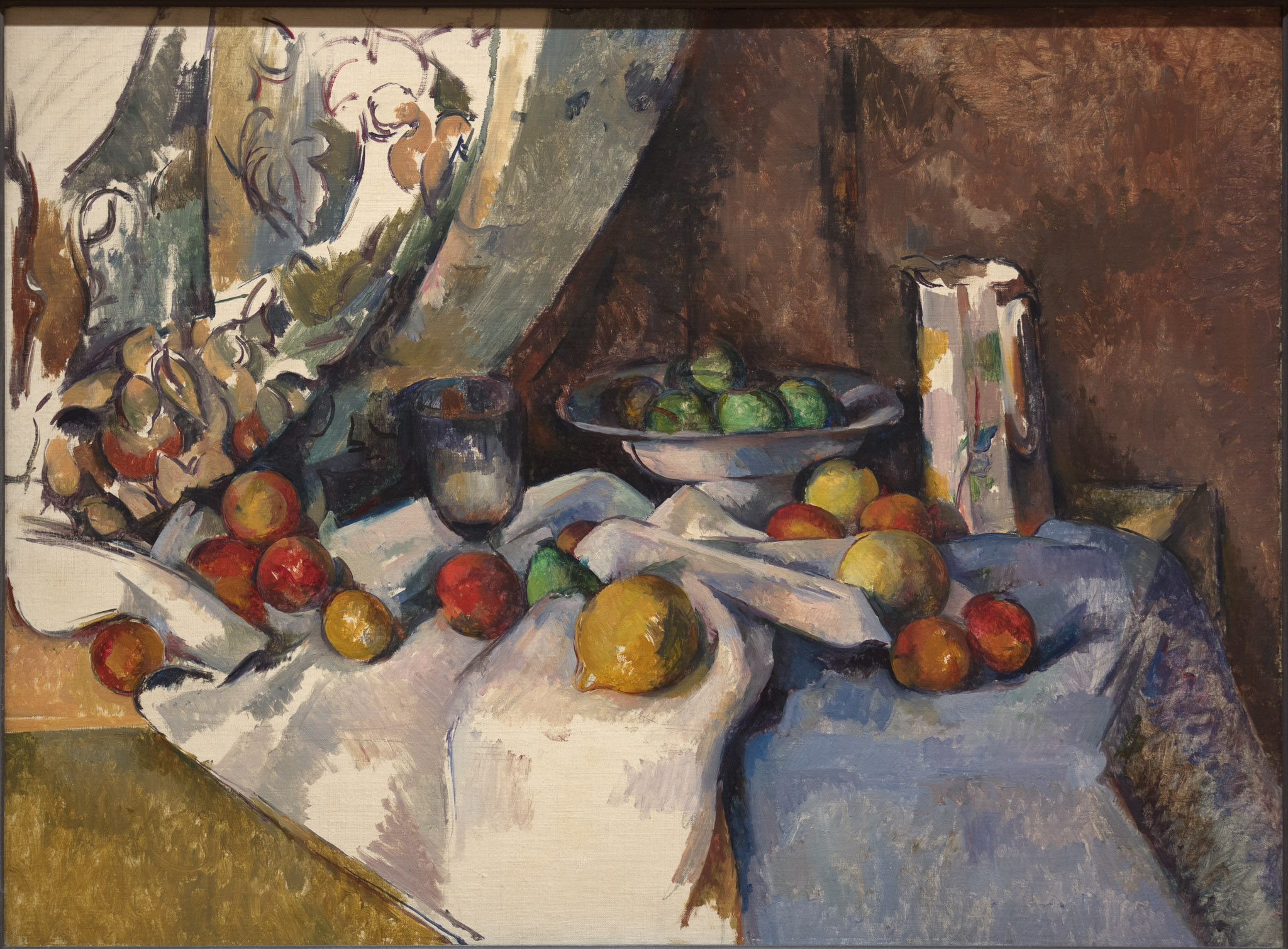
The passage is striking as a reading of Cezanne precisely because we frequently speak of Cezanne’s color modeling in trying to summarize his achievement (at least I do when I teach surveys of art history), and it seems that Hofmann does not view Cezanne’s color modeling as “tonal,” as working toward a representation of three-dimensionality. Hofmann, though, was probably right, regardless of what I tell my beginning students. In the Lillie Bliss Still-Life with Apples, for instance, it is not the case that the color mixtures on the grapefruit at right serve only to create gradations of light and dark (fig. 6).
Nature morte, 1895-1898.
FWN 869
The right edge of the fruit is almost scratched with a scumbled red-brown that is remarkably light for a shadowed edge. The play of light across the top and left of the grapefruit means that yellow bleeds into the white tablecloth. On an apple at left, the brightest red hugs the left side of the fruit that is supposed to recede, and various other patches of bright red and orange also heighten the left side of the fruit irrespective of the point closest to the viewer. The patches become like states on a map, sitting side by side in their distinctive forms. Cezanne’s color modeling is too patchy to be concerned with mere rendering of tonal values through color. Hofmann would have seen that Cezanne’s deployment of color, ostensibly to model, transcends value and modeling in favor of abstract relations. Part of what Cezanne is registering in the Still-Life with Apples has to do with an experience of the whole. An individual piece of fruit is not seen in isolation; by contrast, it casts a shadow on another fruit, or the white tablecloth adds fill light to its underside, or it takes on a tinge of color from the object next to it.
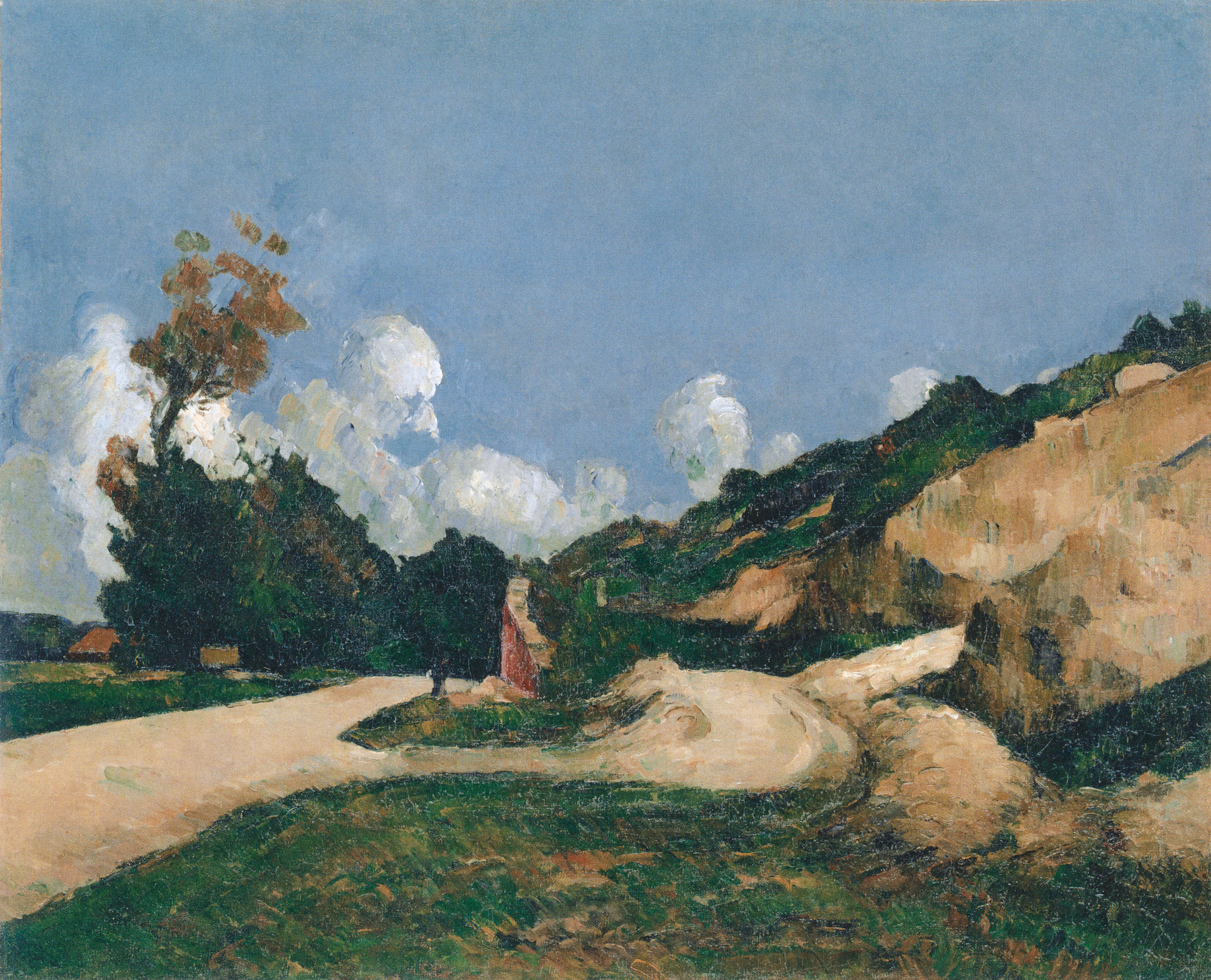
Hofmann would have seen a vivid example of push and pull in Cezanne in La Route, a work that was part of the 1934 Bliss exhibition (fig. 7).[25]
La Route, c. 1871
FWN 58
Like Chocquet Seated, it was among the works Bliss bequeathed to MoMA but was deaccessioned; in the case of La Route, it was in private hands before becoming part of the collection of the Kunstmuseum Basel in 1998. It is dated to c. 1871 and has some of the characteristics of late 1860s Cezannes with its undulating hillside and heavy road. Parts of the landscape and the clouds appear to have been reworked in a “constructive stroke” method that could well have taken place in the mid-1870s.[26] In 1934, Alfred Barr referred to it as “the cornerstone of [Lillie Bliss’s] group of Cézannes,” as the painting was her very first Cezanne acquisition.[27] Alongside The Bather and Pines and Rocks, however, what would have stood out to Hofmann was the overall yin and yang of the composition, divided almost in two between sky and land. As T. J. Clark has observed of Cezanne’s painting after Camille Pissarro’s Louveciennes, a work contemporary with La Route, the landscape creates a measurable distance from a Pissarro-type concern with atmosphere: it is “heavier, thicker…but in the end more solid, more fixed in place by light.”[28] In La Route, the sky is weighed down by its own substance. The sky may be blue, but the air has taken on a material character. It hangs down like a theatrical curtain before meeting the trees and hillside one on one. The road with its bend, which would go on to be a favored motif for Cezanne, looks more like batter poured across the land, then puffing up before solidifying on contact. An essay in the 1934 MoMA catalogue refers to “the rude, primitive projection of isolated masses” of color in place of value; in other words, in 1934 it was already valued as an abstraction of masses rather than as an example of Impressionism or the perception of landscape.[29]
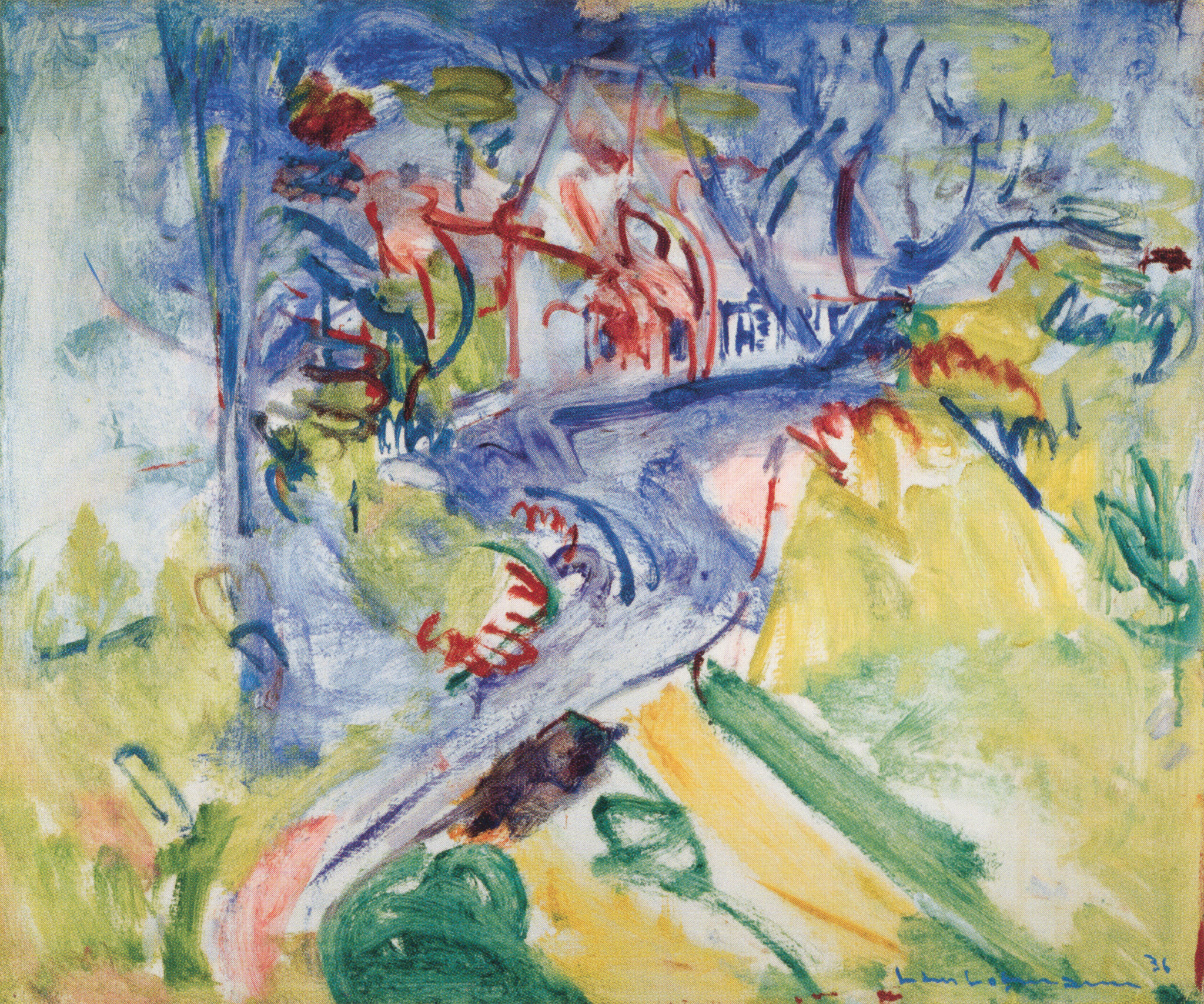
That La Route made an impression on Hans Hofmann in 1934 can be seen in Landscape of 1936 with its undulating hillside at right and its dark blue sky covering more than half the canvas (fig. 8).[30]
Hans Hofmann, Landscape, 1936
Nevertheless, it is thinly painted—more like Raoul Dufy than like Cezanne, and it is part of a series of oil or casein on panel with landscapes of differing configurations. A more apt comparison comes in 1941: an oil on panel Landscape in which brushstrokes of yellow and green earth have been laid on with a weight equal to the deep blue ones for sky (fig. 9).[31]
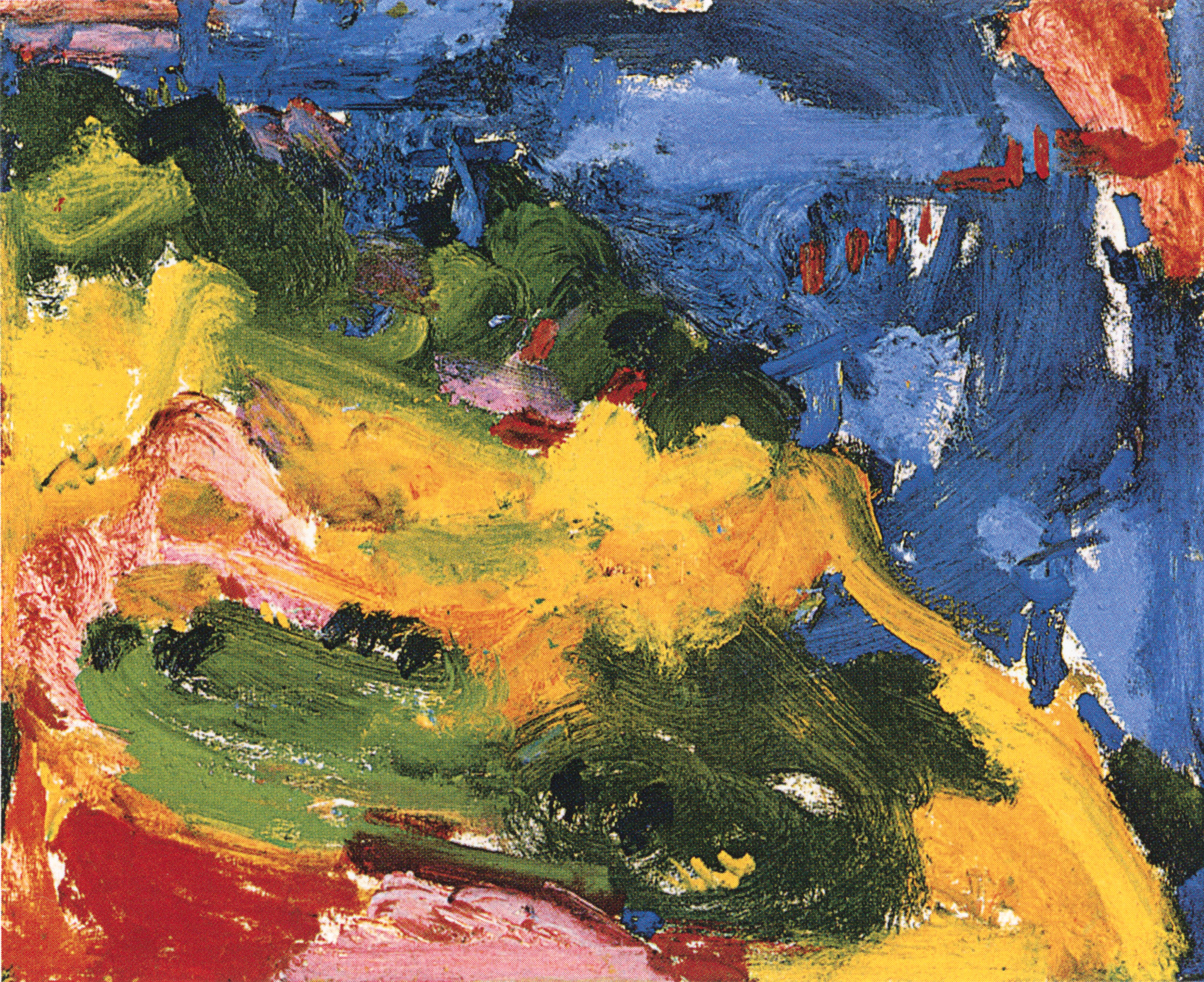
Hans Hofmann, Landscape, 1941
The abstraction is indisputably a landscape, and it is almost the same size as La Route. It became an early example of Hofmann’s push and pull working with larger areas of color rather than the small patches of color in Pines and Rocks, which is what makes La Route such an instructive model. In Cezanne’s example, there may be constructive stroke color modulations on the hillside, clouds, and curving road, but the light congeals rather than weightlessly illuminating the landscape. Light alludes to an opacity rather than trying to replicate a translucency. The material solidity of light in Cezanne’s La Route matters to Hofmann, who, after all, was not trying to paint in a perceptual manner. The kind of light we see in La Route becomes a component of Hofmann’s theory of color in “pure painting.” Here is Hofmann describing the role of color in painting:
In pure painting color serves simultaneously a plastic and psychological purpose. […] Color in itself is Light. In nature, light creates the color; in the picture, color creates light.[32]
Hofmann goes on to describe the manufacture of color relationships by the artist. His statement “color creates light” reveals its situatedness in mid-twentieth-century U. S. painting culture. Painters in Hofmann’s world do not look at landscapes and search for ways to make oil paint register the effects of light they perceive. They are more interested in what happens on the canvas than in nature. It is revealing of Cezanne’s achievement that he could care deeply about looking at the landscape and trying to register his sensations but also conceive of his painting in such a way that seventy years later, an abstract painter would base a theory of push and pull on it—a theory that became foundational to an entire school of painting.
Clement Greenberg attended three lectures that Hans Hofmann gave at his school in 1938–39, and credits Hofmann with influencing his own theories of modern art.[33] When Greenberg included Cezanne alongside Picasso, Matisse, and other foundational figures of modern abstraction that “derive their chief inspiration from the medium they work in,” he noted that he “owe[d that] formulation to a remark made by Hans Hofmann.”[34] Thus we find that the Cezanne in the New York of the 1930s and ‘40s was a modernist Cezanne, an abstract Cezanne. By looking back at the Cezannes that were on view at MoMA, we can better understand not only the work and teachings of Hans Hofmann, but also the idea of flatness that dominated the thinking of Clement Greenberg. In his essay “Abstract Art” of 1944, Greenberg describes a principal feature of modernist painting in the work of Cezanne, writing:
To acknowledge the brute flatness of the surface on which he was trying to create a new and less deceptive illusion of the third dimension, Cézanne broke up the objects he depicted into multiplicities of planes that were as closely parallel as possible to the canvas’s surface, and to show recession, the planes were stepped back with comparative abruptness—even the receding edges of objects keep turning full-face to the spectator like courtiers leaving the presence of royalty.[35]
In a few words, Greenberg describes flatness in Cezanne not in terms of design, but in terms of tension, obligation, formality. Whether it was rocks or apples, the objects in Cezanne turn purposely to the viewer to activate the picture plane and hold it in tension with planes in front of or behind it. The brushstrokes on the hillside of La Route turn toward the viewer like playing cards instead of plunging into recessive depths and crevices. The Cezanne in New York in the 1930s and 40s provided the basis for a new kind of abstract painting, one whose reverberations would be felt in the work of artists like Joan Mitchell, and in the work of every painter who invoked Hofmann’s “push and pull” in approaching a canvas.
Acknowledgments
I would like to thank Daniel Marcus, Christopher Campbell, and my late father-in-law, David M. Campbell. I would also like to thank Denis Coutagne for offering me a chance to present this work to the Société Cezanne at “Odyssée Cezanne,” 25–27 September 2025.
List of Illustrations
Fig. 1. Paul Cezanne, Victor Chocquet Seated, 1877, oil on canvas. Columbus Museum of Art, Ohio (Howald Fund Purchase). FWN 439
Fig. 2. Hans Hofmann, Untitled (Interior Composition), c. 1935, oil and casein on panel. University of California, Berkeley Art Museum and Pacific Film Archive. Gift of the artist, 1965
Fig. 3. Paul Cezanne, Study of Foliage, 1900–1904, watercolor and graphite on paper. The Museum of Modern Art, New York (Lillie P. Bliss Collection). FWN 1980
Fig. 4. Paul Cezanne, Rocks Near the Caves above Château Noir, 1895–1900, graphite and watercolor on paper. The Museum of Modern Art, New York (Lillie P. Bliss Collection). FWN 1390
Fig. 5. Hans Hofmann, House in Storm, 1939, oil on board. Merzbacher Art Foundation (acquired 1990)
Fig. 6. Paul Cezanne, Still Life with Apples, 1895–98, oil on canvas. The Museum of Modern Art, New York (Lillie P. Bliss Collection). FWN 869
Fig. 7. Cezanne, La Route, c. 1871, oil on canvas. Kunstmuseum Basel (Gift of Max Geldner-Stiftung). FWN 58
Fig. 8. Hofmann, Landscape, 1936, oil on panel. Private collection, Norfolk, VA (acquired 1998)
Fig. 9. Hofmann, Landscape, 1941, oil on panel. Private collection (acquired 1996)
Notes
[1] Hans Hofmann, “A talk delivered August 28, 1950 at the Art Association of Provincetown, Mass,” 4, in Hans Hofmann Papers, Archives of American Art, Box 7, Folder 30, digitized: https://www.aaa.si.edu/collections/hans-hofmann-papers-5966/subseries-3-1-3/box-7-folder-30
(image 9 of 36).
[2] On the importance of Cezanne’s work at the 1905 Salon d’Automne for Hans Hofmann, see Tina Dickey, Color Creates Light: Studies with Hans Hofmann (Trillistar Books, 2011), 41.
[3] John Rewald, Cézanne in America: Dealers, Collectors, Artists and Critics, 1891–1921 (Princeton University Press and The National Gallery of Art, Washington, DC, 1989); Jayne S. Warman, “Cézanne Crosses the Atlantic: Vollard and American Collections,” in Cézanne and American Modernism, ed. Gail Stavitsky and Katherine Rothkopf (Montclair Art Museum and The Baltimore Museum of Art in association with Yale University Press, 2009), 78–89; Mary Tompkins Lewis, “Epilogue: Cézanne and Abstract Expressionism,” Cézanne and American Modernism, 124–139. An essay on Hofmann’s interest in Cezannian “harmony parallel to nature” is Jutta Hülsewig-Johnen, “Hans Hofmann: Interior Views of Nature,” in Creation in Form and Color: Hans Hofmann, ed. Lucinda Barnes and Jutta Hülsewig-Johnen (Hirmer, 2016), 123–131.
[4] Lillie P. Bliss and the Birth of the Modern, organized by Ann Temkin and Romy Silver-Kohn, Museum of Modern Art, New York, ran from 17 November 2024 to 29 March 2025.
[5] FWN 869, Nature morte aux pommes, 1895–98, oil on canvas, Museum of Modern Art, New York (Lillie P. Bliss Collection, The Paintings, Watercolors and Drawings of Paul Cezanne, an online catalogue raisonné under the direction of Société Paul Cezanne, formerly directed by Walter Feilchenfeldt, Jayne Warman and David Nash, https://www.cezannecatalogue.com/catalogue/entry.php?id=780 ; FWN 915, Grand baigneur, c. 1885, oil on canvas, Museum of Modern Art, New York (Lillie P. Bliss Collection), The Paintings…of Paul Cezanne, https://www.cezannecatalogue.com/catalogue/entry.php?id=542 .
[6] FWN 439, Portrait de Victor Chocquet assis, 1877, Columbus Museum of Art, Ohio, The Paintings…of Paul Cezanne, www.cezannecatalogue.com/catalogue/entry.php?id=294 .
[7] Its deaccessioning was tied to MoMA’s acquisition of Van Gogh’s Starry Night. Victor Chocquet Seated was the last Cezanne oil painting purchased by Bliss. See Irene M. Walsh, Lillie P. Bliss: Collector, Advocate, and Visionary Benefactor of the Museum of Modern Art (Bloomsbury Visual Arts, 2025), 76 and 148–50.
[8] Hans Hofmann: Catalogue Raisonné of Paintings, ed. Suzi Villiger (Lund Humphries, 2014), 1: 62–63.
[9] Hans Hofmann: Catalogue Raisonné, ed. Villiger, 1: 64–65. On the various Bliss collection exhibitions at MoMA, see The Paintings…of Paul Cezanne, www.cezannecatalogue.com/exhibitions .
[10] Hans Hofmann: Catalogue Raisonné, ed. Villiger, 1: 65. Lucinda Barnes discusses the likelihood of Hofmann’s having seen the Bliss Cezannes in Hans Hofmann: The Nature of Abstraction (University of California, Berkeley Art Museum and Pacific Film Archive and University of California Press, 2019), 18–19.
[11] Meyer Schapiro, Cézanne (Abrams, 1952), 50.
[12] Schapiro, Cézanne, 50.
[13] P52, Untitled (Interior Composition), c. 1935, oil and casein on panel, University of California, Berkeley Art Museum and Pacific Film Archive. See Hans Hofmann: Catalogue Raisonné, ed. Villiger, 2: 37.
[14] Michael Schreyach, “Spacing Expression,” in Barnes, The Nature of Abstraction, 124–129.
[15] On the setting for Portrait of Victor Chocquet Seated, see Mary Morton, “Portraits of Victor Chocquet” in John Elderfield, Cézanne Portraits (Princeton University Press, 2017), 89–91.
[16] Hans Hofmann, “Notes on Art,” Hans Hofmann Papers, Archives of American Art, Box 7, Folder 30, digitized: https://www.aaa.si.edu/collections/hans-hofmann-papers-5966/subseries-3-1-3/box-7-folder-30 (image 13 of 36).
[17] FWN 1980, Étude de feuillage, 1900–1904, watercolor and graphite on paper, Museum of Modern Art, New York (Lillie P. Bliss Collection), https://www.cezannecatalogue.com/catalogue/entry.php?id=1533 .
[18] Hofmann, “A talk delivered August 28, 1950,” Hans Hofmann Papers, Archives of American Art, Box 7, Folder 30, digitized: https://www.aaa.si.edu/collections/hans-hofmann-papers-5966/subseries-3-1-3/box-7-folder-30 (image 9 of 36).
[19] FWN 1390, Rochers près des grottes au-dessus de Château Noir, 1895–1900, graphite and watercolor on paper, Museum of Modern Art, New York (Lillie P. Bliss Collection), https://www.cezannecatalogue.com/catalogue/entry.php?id=1417.
[20] P250, House in Storm, 1939, oil on board, Merzbacher Art Foundation, Hans Hofmann: Catalogue Raisonné, ed. Villiger, 2: 152.
[21] According to Lucinda Barnes, Hofmann’s first published reference to “push and pull” appeared in his essay “The Search for the Real in the Visual Arts,” although he had spoken of the theory in his teaching well before; see Barnes, Nature of Abstraction, 32–33.
[22] Hans Hofmann, “The Search for the Real in the Visual Arts,” in Search for the Real and Other Essays, ed. Sara T. Weeks and Bartlett H. Hayes, Jr. (The MIT Press, 1967), 45; quoted in Lewis, “Epilogue,” Cézanne and American Modernism, 129.
[23] FWN 323, Pins et rochers (Fontainebleau?), c. 1897, oil on canvas, Museum of Modern Art, New York (Lillie P. Bliss Collection), https://www.cezannecatalogue.com/catalogue/entry.php?id=880 .
[24] Hans Hofmann, “The Color Problem in Pure Painting—Its Creative Origin,” 1955, in Karen Wilkin, Hans Hofmann: A Retrospective (Naples Museum of Art and George Braziller, 2003), 39. Original in Archives of American Art, Hans Hofmann papers, circa 1904–2011, Box 7, Folder 7, digitized: https://www.aaa.si.edu/collections/hans-hofmann-papers-5966/subseries-3-1-2/box-7-folder-7 .
[25] FWN 58, La Route, c. 1871, oil on canvas, Kunstmuseum Basel (Gift of Max Geldner-Stiftung), https://www.cezannecatalogue.com/catalogue/entry.php?id=177 .
[26] Theodore Reff, “Cézanne’s Constructive Stroke,” Art Quarterly 25, no. 3 (Autumn 1962): 214–27.
[27] The Lillie P. Bliss Collection (The Museum of Modern Art, 1934), 5. Irene Walsh discusses the painting’s acquisition and fate in Lillie P. Bliss: Collector, Advocate, and Visionary Benefactor of the Museum of Modern Art (Bloomsbury Publishing, 2025), 151.
[28] T. J. Clark, If These Apples Should Fall: Cézanne and the Present (Thames and Hudson, 2023), 46.
[29] Jerome Klein, “Cézanne’s Development as Illustrated by his Paintings in the Lillie P. Bliss Collection,” in The Lillie P. Bliss Collection, 10.
[30] P119, Landscape, 1936, oil on panel, private collection, Norfolk, VA (acquired 1998), Hans Hofmann: Catalogue Raisonné, ed. Villiger, 2: 76.
[31] P337, Landscape, 1941, oil on panel, private collection (acquired 1996), Hans Hofmann: Catalogue Raisonné, ed. Villiger, 2: 201.
[32] Hofmann, “Color Problem,” in Wilkin, Hans Hofmann, 39 (italics original).
[33] John O’Brian, “Introduction,” Clement Greenberg: The Collected Essays and Criticism, ed. John O’Brian, vol. 1, Perceptions and Judgments, 1939–1944 (Chicago: University of Chicago Press, 1986), xxi.
[34] Clement Greenberg, “Avant-garde and kitsch (1939),” in Clement Greenberg: The Collected Essays, 9.
[35] Greenberg, “Abstract art (1944),” in Clement Greenberg: The Collected Essays, 202.
